
Berger on Drawing : John Berger
(Occasional Press. 3rd edition 2008)
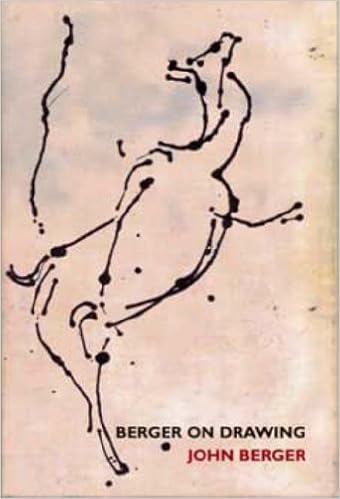
This is a course key text. It is a collection of essays and letters is a broad exploration of drawing in relation to context, philosophy and technique. As I read and reflected I found that I could increasingly relate to Berger’s observations. I found it to be a compelling anthology that triggered many thoughts.
Berger writes about the ‘Point of Crisis’ when drawing (p.8), that is the urgency to tweak the image drawn before accepting completion. This is, certainly in my own experience, a truth of the creative process.
He identifies drawing as becoming the subject, representing lovingly, measurement becoming intuitive, saying :
” To draw is to look, examining the structure of appearances. A drawing of a tree shows not a tree but a tree being looked at… From each glance a drawing assembles a little evidence but it consists of the many glances which can be seen together.” (p.71)
Berger reflects on how Van Gogh’s representations of the world around him are portrayed literally and with ‘Currents of Energy’ (both his own and that of his subjects). “He became strictly existential, ideologically naked. The chair is a chair, not a throne. The boots have been worn by walking. The sunflowers are plants, not constellations…”. (p.13) Yet we marvel at his work and I find it so significant that Berger called this chapter simply ‘Vincent’ knowing that we need no further clarification.
When considering the drawings of Watteau, Berger celebrates subtle delicacy as “more powerful because it was not a shout”. (p.39)
Berger takes us with him on voyages of investigation into drawing. In the chapter ‘Le Pont d’Arc’ Berger inspects the cave drawings of Cro-Magnon people. These precious exhibition spaces… caves where the people came to perform rites in a space shared with bears, their claws too making their own autobiographical marks. In an aim to create an empathic experience Berger recounts drawing on highly textured and porous Japanese paper with ink – presuming it would “take me a little closer to the difficulties of drawing with charcoal (which was burnt and made here in the cave) on rough rock surfaces. In both cases the line is never quite obedient. One has to nudge, cajole.” (p.92)
As I am developing my practice I am reflecting more on the context and focus of my processes as well as the outcomes. Reading Berger’s observations has resonated with my thinking. In particular I found his identification of ‘space’ in drawing to be very thought provoking. He writes that three spaces exist in drawing :
- The place we are drawing in
- The space that the drawing puts us in
- The movement between the one who is drawing and what is being drawn (p.123)
This symbiosis is what (no pun intended) draws me to drawing. As Berger notes, when drawing your hand touches the surface in way that it rarely does when painting. I prefer to work on surfaces that I feel contribute to my work by sometimes working against it – textured paper, recycled card, parcel paper. It is the story of the process that I find as significant as the final outcome. “Drawings reveal the process of their own making…”(p.70)

 Learning Log : Exploring Drawing Media