
Contextual Study point 8 : Extending a line into space
Drawing : Sculpture was an exhibition held at the Drawing Room in London in 2013. 21 works, by 7 international contemporary artists, that challenged and blurred the distinction between the two art forms
The suggested links, that preview the exhibition, state that these works have moved away from drawing as preparation for, or a recording of, sculpture.
Looking at these works have enabled me to develop an understanding of the premise of this method, as well as prompting an enthusiasm to explore possibilities.
Sara Barker : On her Saatchi profile, “Sara Barker’s works don’t simply breach the boundaries between painting and sculpture, they are that boundary. Skeletal structures in aluminium and steel describe wonky rectangular shapes in the air in hesitant lines, as though uncertain of themselves; their forms are those of sketches, not sculptures”. (Ben Street)
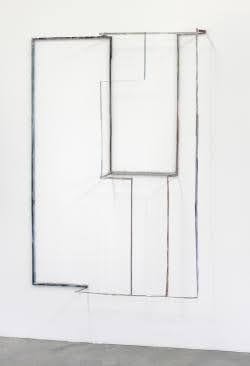
Sara Barker ‘Words Are Form’ (2010)
Aluminium, grey & white metal filler, primer, gouache, oil paint, glue, rivets, bolts
(158 x 119 x 15 cm)
I chose this piece because it absolutely blurs that line for me. I am drawn to the delicacy of the line and enjoy this effect of the piece and the way that structural materials can enable this.
I also really enjoyed the featured work by Knut Henrik Henriksen.
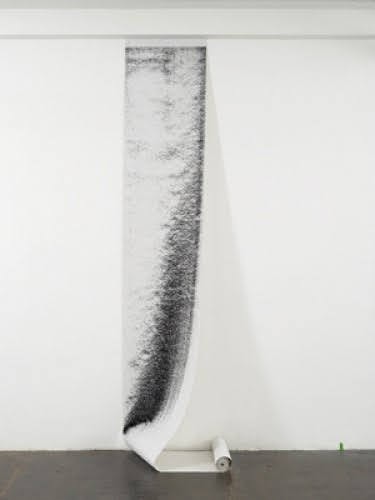
Knut Henrik Henriksen, Untitled, 2011 Woodchip wallpaper, charcoal dust, variable dimensions
I like how Henriksen has explored texture and structure in this piece. Closer inspection of a range of practice ( https://www.knuthenrikhenriksen.com ) reveals an architectural approach.
I like how he uses structural elements to redraw a space, reimagining line and shadow, as shown in the piece below.

V I. Domestique 2006 Installation view
References
https://drawingroom.org.uk/exhibitions/drawing-sculpture
http://thisistomorrow.info/articles/drawing-sculpture
Sara Barker CHANGE-THE-SETTING at The Fruitmarket Gallery 12 March – 5 June 2016 at : https://www.youtube.com/watch?v=xdN2R5ljfFM (accessed 20/06/2020)
https://www.knuthenrikhenriksen.com/knut-henrik-henriksen-bern
Knut Henrik Henriksen “A story about the sun and the moon” at https://www.youtube.com/watch?v=umGYsgQf6G8 (accessed 20/06/2020)
https://www.standardart.no/en/exhibitions/domestique
Exercise 3.1 Constructing a drawing
The aim of this exercise is to revisit the tonal collage drawing from Exercise 2.2 and produce that drawing as an object. I find this a really interesting exercise as to inspire the tonal drawing I had made clay free form structures. This exercise brings the drawing full circle!
Process :


I painted cardboard Amazon delivery envelopes in four tones from white to black. I had thought initially that I would make complete 3d structures.

As I started to work I decided that I would instead make interlocking pieces that would represent the collaged drawing, rather than the clay structures that I had initially made for the original task. I opted to do this as the slightly waxy, springy material that I was working with was quite resistant to folding and joining.
I worked on ways to cut and slot, making 3d interlocking pieces.

Using two pieces of gessoed canvas boards, I constructed a base for the structure. I then built up the the tonal areas.


When I had completed the construction, I took a close range black and white photograph.
 I then compared the photographed spatial construction with the original collaged tonal drawing.

Reflection
I am really pleased with both the process and the outcome. I like the simplified tonal elements of the 3d drawing. Some of the tonal replication is not quite as accurate as I would like but I am satisfied that this is an impression of the original rather than a direct copy. Clearly an aspect of that is the range of collage materials that I used originally added further tonal variation. I feel that I learned much during this process in terms of deconstructing an image to a simplified form. This enabled me to look at the elements that I could see as a kind of tonal jigsaw rather than focusing on the image as a whole.
Exercise 3.2 Back to two dimensions
Aim to make a 2d drawing from spatial construction
Preliminary drawings : 7b pencil and drawing ink.


Charcoal and soft pastel :

Top to bottom : Tonal collage drawing – Tonal spatial construction – Tonal drawing

Reflection:
Do you feel that making a three-dimensional model helped you discover new qualities about your subject? It was a really interesting stage to the process. When drawing the model using directed light I noticed that there were new tonal elements to the drawing including the shadow of the structure against the constructed base. Making the 3d model added to my recall of the form when drawing (like muscle memory) but also encouraged me to look more closely as I drew this newly constructed physical object as distinct from the previous stages of this series of pieces which started with the clay forms.
Which drawing do you prefer? I really like the experience of deconstructing a 2d drawing to produce a 3d version. While working on this I thought of how I could apply this to other drawings. I like the soft pastel drawing of the model too and how the tonal variation appears more nuanced due to the direct light on the 3d form.
How has the switching back and forth supported your understanding of a possible art process that encourages experimentation, investigation and development? Absolutely! This process has got my brain whirring,thinking about the possibilities… It has been a satisfying process and I enjoy the connectivity between the drawings.
How has your understanding of drawing as a discipline been informed by the course so far? The course is encouraging me to reflect on and evaluate what I think I understand about drawing. It is reaffirming my love of drawing and introducing me to a wide range of possibilities beyond sketchbook and pencil. I am being continuously drawn back to Berger’s comment that ‘Drawings reveal the process of their own making.’
Contextual study point 9 :Roman Ondak and Karina Smigla-Bobinski
This study looks into the ways in which the artists Roman Ondak and Karina Smigla-Bobinski affect space and the way it is experienced.
Ondak’s work ‘Measuring the Universe’ was an interactive installation in Tate St Ives which started with an empty space with blank white walls. As visitors entered the space they became participants, invited to record their height and name on the wall.

Roman Ondak ‘Measuring the Universe 2007’. Presented at Tate St Ives, 2011.Courtesy of the artist
Over time with the mass of visitors the tonal bands developed created a new depth and horizon to the space. Defined by height, the participants developed strata. I find this to be a sensitive process that is organic and highly engaging.
I found this to be particularly personal. Since the start of the lockdown I have been teaching a mixed age group of the children of Key Workers (4 to 11year olds); mostly art and science to enable equal participation. With this disjointed group who are emotionally vulnerable and dysregulated, I decided to prompt a sense of community by developing a group height chart that includes the staff and children who participate in the group over the week. It is referred to daily by the children, checking to see if they have grown over the 12 weeks and then remarking their height where appropriate.
Karina Smigla-Bobinski’s ADA has been described as an ‘artwork with a soul,… Filled up with helium, floating freely in room, a transparent, membrane-like globe, spiked with charcoals that leave marks on the walls, ceilings and floors. Marks which «ADA» produces quite autonomously, although moved by a visitor. The globe obtains aura of liveliness and its black coal traces, the appearance of being a drawing . The globe put in action, fabricate a composition of lines and points, which remains incalculable in their intensity, expression, form however hard the visitor tries to control «ADA», to drive her, to domesticate her. Whatever he tries out, he would notice very soon, that «ADA» is an independent performer, studding the originally white walls with drawings and signs.’ (Arnd Wesemann. https://www.smigla-bobinski.com/english/works/ADA/index.html).
Like Ondak’s piece, ADA is an interactive installation that redefines the space. Unlike Ondak’s piece, ADA is able to function as a mark-making entity without the participants; however it is their interaction that causes ADA to dance and respond. Ondak’s walls would remain blank if it were not for his visitors.
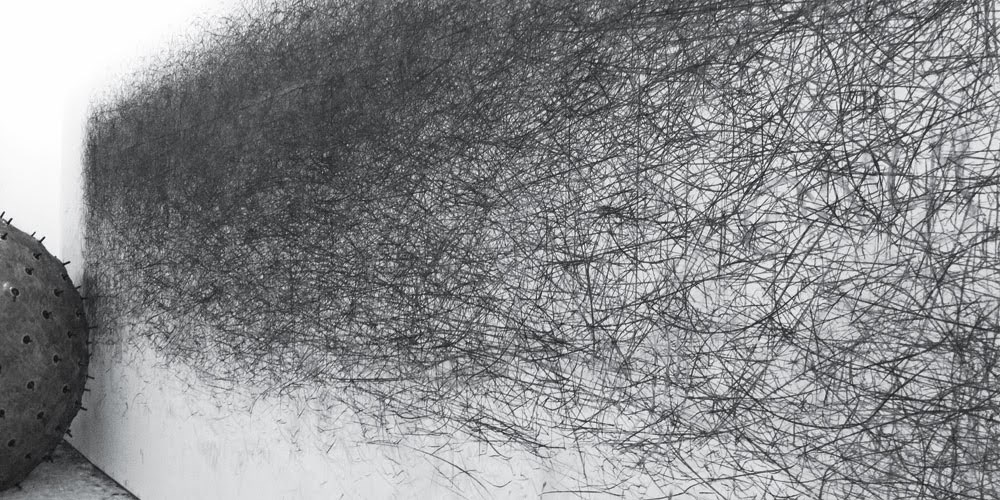
Smigla-Bobinski,Karina. ADA – analog interactive installation / kinetic sculpture / post-digital drawing machine.
I enjoyed researching both these works and feel they act successfully as comparison pieces. I enjoy Ondak’s work especially. This is because it speaks to me of a common experience. I can empathise with the participants and the impact of being part of a growing installation in such a personal way. Also I like how the mark-making gives the sense of expanding the space. That’s not to say that I don’t love the texture of the mark making created by the interaction with ADA, because I think it is great. I just like the direct interaction of Ondak’s piece more.
References
Roman Ondak, Measuring the Universe (2:57) at www.tate.org.uk/context-comment/video/tateshots-roman-ondak-measuring-universe (accessed 03/07/20)
Karina Snigler-Bobinska, ADA ( 3:51)at https://www.youtube.com/watch?v=OcNtvfALW1Y (accessed 04/07/20)
https://www.smigla-bobinski.com/english/works/ADA/index.html
Exercise 3.3 : Affecting the way a space is experienced
The premise of this exercise is to affect a room(and the way it is read or felt) by using a three – dimensional drawing.
For the exercise I chose my kitchen. It is a linear space that tends to be inhabited mainly by me, with my family (including Olive the dog) being occasional visitors. I chose not to tell them of the alterations that I would be making, hoping that this would make their interactions more spontaneous.


Preparation :
I started by making a line drawing of the space. It is a galley kitchen, long and narrow. I wanted to add layers to room through my drawing and affect movement in the room, creating barriers.

I planned two ideas that I wanted to explore – a web and lines of light. The material for the web would be string and for the lines of light, geometric cuts into cardboard refracting light from an anglepoise lamp. I chose string because I did not want a contrasting line,rather one that with light and similar to the colour of the cabinets so that it felt part of the room rather than a clunky addition. With the light, I wanted to create a pathway that was not directed towards to door.


Outcomes and observations
As I strung the room to make the web, I was directed to create layers and in doing so,this changed my ways of moving through the space; weaving, crawling, moving through the refracted triangular areas that I created.


It was my daughter that first entered the room. Her response was really interesting “Wow look at all these triangles!” She then decided that she would need to crawl under the web so that she could ‘start the journey through’.

She then began to climb over and through the grid, pulling the string up and down to enable a very active interaction.


About an hour later, my husband returned from work and, with much less enthusiasm to the altered space, decided that he would need to roll across the floor to be able to get to the garden via the far door.


Later that evening, when the room was suitably dark, I altered the space again, this time by using a cutout drawn line in cardboard, attached to an anglepoise lamp. Again, I managed to do this undetected.


Refection
in the current Covid 19 climate it made sense to me to use a room in my home for this exercise, with my family as participants.
I found it really interesting the way in which the string web was reacted to in different ways. It was logical for my daughter to explore the layers of the structure, taking a playful approach, likening the lines to lasers as she took the role of ninja spy. Conversely, my husband felt that the structure was delicate and that he needed to avoid breaking it.
In terms of the drawing with light, it was interesting to see how my daughter was equally engaged in moving through the dark and the light. She was inspired to create shadows and to try to merge into the dark so that she ‘not break the lines of light’.
Watching their reactions and interaction gave me the realisation that they were the art. It is their response that gave my actions context and meaning.
Exercise 3.4 : Installing a drawing
There has been a considerable hiatus in my art work and studies. This has been a consequence of my husband leaving our marriage and home during the lockdown. I have spent much time re-evaluating my sense of self and my surroundings. I think my abstinence from making art has primarily focused on me not wanting to make personal or painful statements about the experience.
I am now at the point where I can see possibilities in my situation and having extensively redecorated and re-purposed spaces in my home, this exercise of installing a drawing is both timely and welcome.
The room which had been my husband’s office has been the most difficult room to tackle. It was the room where he spent most of his time and indeed where he planned his escape. The metamorphosis of the space has been pivotal in my increased sense of well-being and forward thinking resilience.
The room’s rebrand as ‘The Snug’ evokes for me a warmth that is successfully overpowering the sense of sadness and dread that I had about the room and its previous connotations. It is a place of comfort, light and relaxation. A place of contrast – to read and reflect or play out my emotions on the drums.
Thinking
When considering the approach that I would take to my installation, I reflected on Berger’s observations on cave drawings and how, as site specific installation. they narrated a story of both the people and the space. My reflection on the space, my evolving experiences and the purpose of my installation culminated in my ideas for a text based installation – a statement of intent. This intention guided my research.
Research
I looked at the work of contemporary artist Kristin Bauer. I really like the way that she uses text – boldly and in a way that both complements and enhances the site.
https://kristinbauerart.com/installations-art-word-art-using-words
I considered also the work of Nicola Antony. I am particularly drawn to ‘Our time’, a hanging sculpture of poetry in Burmese and English/Singlish.
https://nicolaanthony.co.uk/upcoming-exhibitions
Inspiration into planning
I have considered the significance of a ‘snug’ and the meaning of the word. Additionally I have looked at the origins of the word from Scandinavian languages, as well as the significance in nautical terms – the preparation for a storm by lashing down of deck gear, the smoothing of fuzzy fibres of a rope, tightening, increasing security. This seemed very significant to me. From the window of the snug I can see the willow tree in my garden that died at the beginning of the lockdown. The symbolism of this felt too relevant to disregard.
Subsequently while drawing my ideas I thought in terms of the tree’s fragility and the parallels to my recent personal experiences:ideas of nests, security, binds and contact dominated my ideas. The need for regrowth and nurture being a strong theme for me.


Installation
My preference is to work with found materials so for this exercise I chose to work with cardboard and twine. My concept for the piece ‘Bound’ is that the tree is coming into the snug, its frail and fractured branches reaching into the warmth of the room; changing and enhancing the space.


Reflection
The shadows are as important to the installation as the structure itself. They add a sense of depth and also a nod to loss and anticipation. The piece took a day to construct and install and was very delicate in the making. By the following morning, it was no longer intact and I felt that this was apt and appropriate to the work. Starting the work was a challenge as I was pulling myself from a stasis of creative fog. This work has had significant meaning for me and marks for a me a sense of authenticity in my work.
 Learning Log : Exploring Drawing Media